Are you wondering what CMS platform to use for building your website?
A CMS (Content Management System) platform lets you easily create a website without understanding any code (at least for most of them). There are lots of CMS options available, which means you might struggle to choose the best CMS for your needs.
In this article, we’ll be explaining why it’s so important to choose the right CMS platform for your website. We’ll also share our top picks for the best CMS platforms along with a comparison.
What is a CMS Platform?
A CMS platform (content management system platform) is a piece of software that allows you to easily manage content and create a website.
Normally, web pages are written in HTML, JavaScript, and CSS programming languages. If you were to build a website without a CMS platform, then you would need to learn these languages and write a lot of code.
CMS platforms solve this problem by allowing you to make a website without writing code or learning programming.
Unless of course, you’re looking for a developer-friendly CMS which means you already know how to code.
How to Choose the Best CMS Platform for Your Website
There are lots of different CMS platforms out there, so which one should you pick? Before you we jump to our CMS platform comparison, here is what you should look for in a good CMS.
Ease of use
You want a CMS that makes it easy for you to create and edit content. This often means having a drag and drop interface, so you can add different elements on your pages.
It should be quick and straightforward for you to make changes to the content on your site after publishing it.
Design options
Your CMS software should offer you plenty of website design templates to choose from. It should also allow you to easily customize those designs to your own requirements (ideally without writing code).
Data portability
A great CMS platform should have tools for you to easily export your data and move it elsewhere.
For instance, you may later decide to choose a different platform or a different hosting company. Data portability makes it easier for you to move around with complete freedom.
Extensions and addons
Not all websites are the same. This is why it is impossible for any CMS platform to come with all the features that would fulfill requirements for every website.
Extensions and addons fix that problem. These are separate software that you can just install on your CMS software to extend its features and add new ones when needed. Think of them as apps for your CMS platform.
Help and support options
Although CMS platforms aim to make building a website as straightforward as possible, you still might have some questions. Find out what help and support is available if you get stuck.
Some CMS providers will have a handful of FAQs and a customer service team that’s painfully slow to respond. Others will have a big supportive community that can help you any time of the day or night.
How much does it cost?
Some CMS platforms are completely free. Others charge a monthly fee. Even with free CMS platforms, you’ll often need to pay for third-party extensions, designs, and/or web hosting services.
Try to find out as much as you can about the pricing before you choose your CMS, so you don’t have any nasty surprises.
With these things in mind, let’s take a look at the best CMS platforms to choose from.
1. WordPress.org
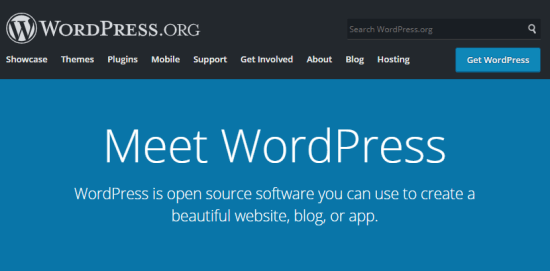
WordPress.org is our number one choice for the best CMS platform. It’s the world’s most popular CMS software, and it powers around 35% of all websites on the internet.
It’s important to not confuse WordPress.org with WordPress.com. WordPress.org is a free open source CMS originally designed for blogging, but now it’s used by all sorts of websites / online stores. WordPress.com is a blog hosting platform.
If you’re not sure about the difference between the two, check out our detailed comparison of WordPress.org and WordPress.com.
Note: When we talk about WordPress on WPBeginner, we normally mean WordPress.org. We specify WordPress.com where appropriate.
You need to host your WordPress site yourself, which means finding a suitable WordPress hosting provider.
Pros
- WordPress offers you the flexibility and freedom to build any kind of website (online store, auction site, membership site, etc).
- It does not require any technical skills or coding knowledge. The WordPress block editor makes it really easy to create great looking pages on your site.
- You have complete freedom to make money online from your website in any way you want.
- There are thousands of WordPress themes and plugins available, both paid and free. These let you add all sorts of useful extras to your site, like contact forms, photo galleries, and much more.
- WordPress is really well designed for search engine optimization (SEO). It’s easy to create SEO-friendly URLs, categories, and tags for your posts. You can also choose from plenty of SEO plugins to help you do more.
- There’s a huge and supportive community around WordPress, as it’s an open source CMS. You can join groups like the WPBeginner Engage Facebook group to get help with any problems you run into.
- WordPress offers a lot of extensibility which is what makes it an ideal CMS platform for both beginners and developers alike.
- WordPress lets you download all your content in XML format, making it easy to move to a different system in the future if you choose to do so.
Cons
- You’ll need to set up your hosting and domain name, and you’ll be responsible for managing things like security and backups.
- Because WordPress offers so many options and so much flexibility, it can sometimes feel a little daunting when you’re getting started. This is why many beginners use drag & drop page builder plugins for WordPress.
Pricing
WordPress itself doesn’t cost anything. However you’ll need a domain name (around $9 – $15 per year) and a hosting account with a web host that can run WordPress (normally from $7.99/month).
We have a special deal with Bluehost where you can get WordPress hosting for just $2.75/month which includes a free domain and free SSL.
If you need some help getting your WordPress site started, check out our guide on how to make a website with step by step instructions.
2. Joomla
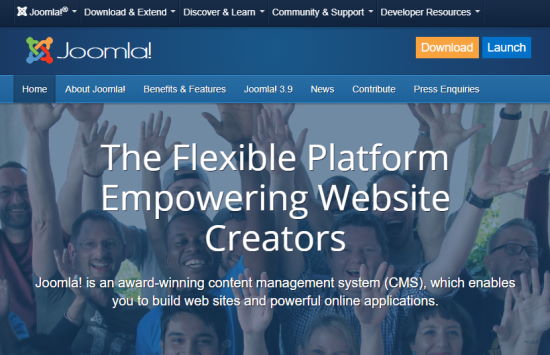
Joomla is another popular free open source CMS platform that comes with lots of different templates and extensions. It’s free to use, but you’ll need hosting and a domain name.
It was first released in 2005, so like WordPress, it’s been going for years. Joomla is packed with features, and many web hosts offer a 1 click installation. However, it’s really an ideal CMS platform for developers and experienced website creators, so it’s not such a good option for beginners.
Pros
- Joomla gives you lots of flexibility and plenty of options. It’s a good choice if you’re building something complicated or bespoke.
- Although Joomla is particularly useful for developers, you can still use it even if you don’t want to ever touch a line of code. It’s easy to edit your content.
- Like WordPress, Joomla is open source, and there’s lots of community support available if you get stuck.
- You can use Joomla to run an e-commerce store as there are extensions available for this.
Cons
- Even Joomla fans will admit it can be pretty complex. Depending on what you want to do with it, you may well need to hire a developer to help out.
- There aren’t that many options for additional extensions. If you’re used to a CMS like WordPress, which has thousands of available themes and plugins that extend the core functionality, you might be disappointed by Joomla.
- There can be some compatibility issues if you have a lot of different extensions and modules installed.
Pricing
Joomla itself is free, though you’ll need to pay for a domain name and web hosting that supports Joomla. SiteGround is a good option here, as they have specific Joomla hosting plans with lots of handy features.
You may find yourself paying for some extensions to add more functionality to your website. You might even want to budget for getting help from a developer, depending on what you’re trying to achieve.
3. Drupal
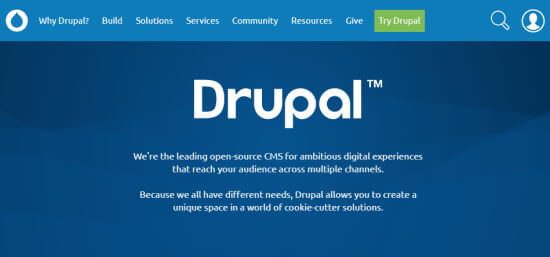
Drupal is another open source CMS platform. It’s the CMS behind some major websites, including The Economist’s site and a number of university’s sites.
Drupal is a good option for developers, or for people able to hire a developer. It’s especially good if you’re aiming to build a highly customized site that needs to handle a lot of data.
You can host a Drupal site on SiteGround. They offer free installation and can even help you transfer an existing Drupal site.
Pros:
- It’s easy to add content on Drupal. The custom content types are flexible and offer plenty of options.
- There are lots of different modules available that you can add to your site (these work like WordPress plugins).
- Support is available via community support options similar to other popular platforms like Joomla and WordPress
- User management is easy, with a built-in system where you can create new roles and specify their permissions.
Cons:
- With Drupal, it can be tricky to figure out how to change the appearance of your site or add extras. It’s definitely not as beginner-friendly as WordPress.
- Most Drupal websites have a heavily customized theme created by a developer, which can be very expensive.
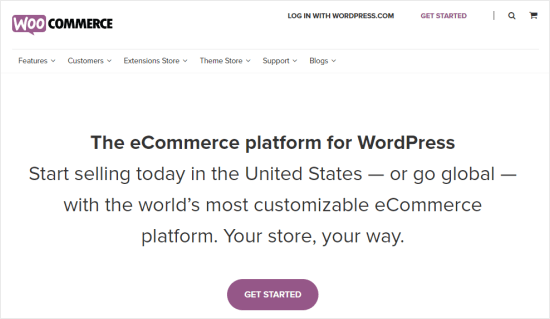
WooCommerce is the most popular eCommerce platform in the world. It’s really flexible and it’s easy to manage.
WooCommerce isn’t technically a CMS platform itself. Instead, it runs as a plugin on WordPress, so you’ll need to have WordPress on your site in order to install WooCommerce.
If it was a CMS platform, though, it’d have 5.8% of marketshare, according to W3Techs. That’s the percentage of all the websites in the world that use it.
Pros
- WooCommerce is available as free software, but you’ll need WooCommerce hosting and domain name to get started.
- There are lots of WooCommerce themes available, which makes it really easy to get your site looking exactly how you want.
- WooCommerce has lots of available extensions (known as WooCommerce plugins) that let you add extra functionality to your site.
- You can sell physical or digital products using WooCommerce. You can even sell affiliate products through affiliate links.
- You can fully manage your inventory through WooCommerce, making it easy to keep track of what you have in stock.
- WooCommerce comes with PayPal and Stripe payments by default. You can also add any other payment gateways through extensions and add-ons.
Cons
- There are a lot of different options in WooCommerce, which can be a bit daunting when you’re new to setting up a website.
- WooCommerce technically works with any WordPress theme, but you may want to stick with themes made specifically for WooCommerce for extended support.
Pricing
The WooCommerce plugin itself is free, but you may need to pay for extra plugins and extensions for your online store.
You’ll also need to pay for a domain name and a web hosting account. Bluehost is a great web host to pick as they’ll install WooCommerce and the Storefront Theme for your site for you.
5. BigCommerce
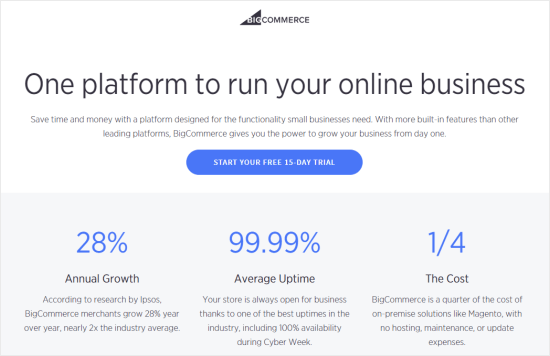
BigCommerce is a fully hosted eCommerce platform, which is sometimes called an all-in-one platform. It’s easy to get started with if you’re a beginner.
BigCommerce hosts your site for you, as well as providing the actual CMS platform itself. It also handles security and backups for you.
Pros
- There’s a trial plan, so you can give BigCommerce a go before committing.
- You can use a free domain name from BigCommerce, which will look something like mystore.mybigcommerce.com, or you can pay for a custom domain name.
- There are lots of different ways you can take payments through BigCommerce. Customers can use digital wallets like PayPal, Apple Pay, and Amazon Pay, or they can pay by credit or debit card.
- BigCommerce has support options that you can access straight from your dashboard, 24/7. These include live chat, email, phone support, community support, and more.
- You can use BigCommerce with WordPress if you want to, which can give you the best of both CMS platforms.
Cons
- BigCommerce doesn’t give you as much control over your store as WooCommerce. There are limited themes and integrations which may hold you back from using a third-party service to grow your business.
- Once your sales reach a certain threshold per year, you’ll be automatically moved up to the next level of the pricing plan. This could be difficult for you if you have a lot of expenses.
Pricing
You need to pay a monthly subscription to use BigCommerce, which means it’s not so cost-effective as some other solutions. With all the plans, you can save a bit of money by paying upfront annually instead of paying monthly.
The cheapest pricing plan, Standard, is $29.95/month, for up to $50k/year sales. The priciest is the Pro plan for $249.85/month, which will cover you up to $400k sales. You’ll need to get a custom Enterprise plan after this.
6. Shopify

Shopify is another all-in-one hosted CMS platform. You won’t need to buy hosting, install any software, or manage things like updates and backups.
It has a straightforward drag and drop interface. It supports in-store sales, which is great if you have a physical store as well as an online one.
Pros
- You can accept credit and debit cards through Shopify’s integrated payment solution, Shopify Payments. PayPal is also included as one of Shopify’s default payment providers.
- There are lots of extensions and themes available for Shopify. You can buy third-party Shopify apps that let you add all sorts of features to your online store.
- You don’t need to upgrade if you make over a certain dollar amount in sales, like you do with BigCommerce.
- Shopify has 24/7 support through live chat, email, phone, and even Twitter. There’s also lots of documentation available (including written how-to guides and video tutorials) plus online forums.
Cons
- Your costs can end up quite high, especially if you want to add lots of third-party apps to your store.
- You may find that you want to add functionality that simply isn’t available: Shopify’s apps are more limited than things like WordPress’s plugins.
Pricing
Shopify’s pricing plans are similar to BigCommerce’s options. There’s one major difference, though. Shopify doesn’t make you move up to the next plan based on a certain dollar figure in sales.
The cheapest plan is $29/month. The most expensive is $299/month and includes more features. You get a discount for paying for a year upfront.
7. WordPress.com
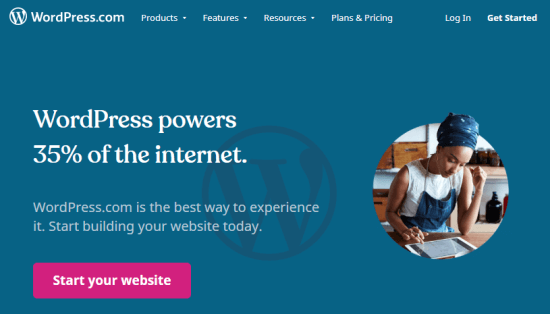
WordPress.com is the commercial, hosted version of WordPress. It’s easy to confuse it with WordPress.org, which is open source, self-hosted WordPress.
If you’re not sure about the difference between WordPress.com and WordPress.org, you can find out more here.
With WordPress.com, you get an all-in-one CMS platform that’s hosted for you. You can purchase a domain name or use a free subdomain with WordPress.com branding.
Pros
- WordPress.com is easy to get started with. You can add and edit content easily, and beginners tend to find it a straightforward CMS to use.
- You can create a site with WordPress.com completely free of charge. You’ll probably want to pay for at least the cheapest plan, though, so you can use your own domain name.
- There are different themes (designs) available for your WordPress.com site. You can easily switch between these in your WordPress.com dashboard.
- As your site grows in size and popularly, you can upgrade to a new plan. There are lots of options, including a plan with eCommerce features.
- WordPress.com has built-in analytics, which means you can see statistics about how many people are visiting your site in your dashboard. This does mean you can’t use Google Analytics, though, unless you’re on a Business Plan.
- It’s quite straightforward to switch from WordPress.com to WordPress.org in the future, if you decide to change to a more powerful and flexible CMS.
Cons
- WordPress.com has limited monetization options even with their business plan.
- You can’t add a custom domain name unless you pay for at least the cheapest paid plan.
- While there are plugins you can use for your WordPress.com site, there aren’t nearly so many available as there are for WordPress.org.
- You don’t have the full control over your site that you’d have with WordPress.org.
Pricing
There is a free WordPress.com plan available, but if you’d like your own domain name (and you want to avoid WordPress putting ads on your website), you need to choose one of their paid plans.
The cheapest is $48/year ($4/month), or you could move up to other plans, including the eCommerce plan for online stores for $540/year ($45/month). Beyond this, there are WordPress VIP options offering additional features.
8. Ghost
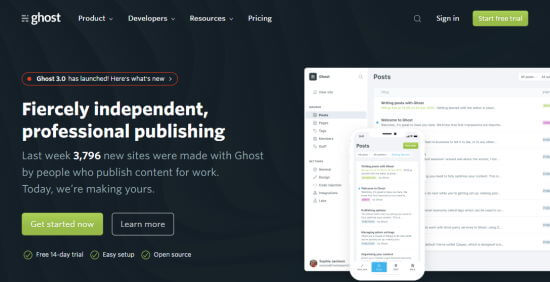
Ghost is a CMS platform specifically designed for bloggers. You’ll often hear it described as a “headless CMS,” which might sound quite odd. This just means that the CMS platform doesn’t force content to be delivered in a specific way.
So, the content or data you produce could be shown on a website, but it could also be sent to a mobile app or something else entirely. If you’re not a developer, though, or you just want to use Ghost for blogging, you don’t need to worry about this.
Pros
- You can use Markdown when you’re writing in the Ghost editor. Markdown is a way of formatting text where you add special characters around words to make them bold, italic, and so on.
- Ghost has a content editor that uses cards. These work a bit like WordPress’s blocks in the block editor.
- There’s great support for SEO (search engine optimization) built into Ghost. You don’t need to add any plugins to deliver this.
- Ghost is well set up for charging for content, so if you want to run an online magazine or publication that people pay for, you can do this easily.
Cons
- Ghost doesn’t offer the same amount of power and flexibility as WordPress.
- Although Ghost started off as a CMS platform designed just for blogging, some users feel it’s become overly complicated as it now offers things like paid subscriptions for your site’s readers.
Pricing
The Ghost software itself is free, but you’ll need to pay for a domain name and web hosting. Unlike bigger CMS platforms, Ghost isn’t supported by all that many web hosts.
You can get Ghost hosting from Ghost(Pro). The basic plan is $36/month, but you’ll need to upgrade if you want extra staff users or subscribers, potentially paying as much as $249/month.
9. Magento
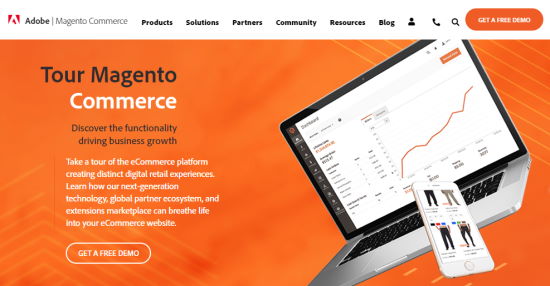
Magento is a powerful open source eCommerce platform from the huge software company Adobe. There’s a free version you can download and install on your own web hosting account, called Magento Open Source.
If you want to use this, then SiteGround Magento hosting would be the easiest way to get started.
If you prefer, then you can pay for Magento Commerce. This comes with full support, and is hosted for you, but it’s very expensive.
Pros
- Magento is highly customizable, with lots of third-party extensions available that you can use to add extra features.
- With Magento, you can handle lots of products and customers. It lets your business grow easily, without your site slowing down. (You’ll likely need to upgrade your hosting plan, though.)
- There are some really big name brands using Magento, including Nike, Ford, and Coca Cola.
- You can connect different payment gateways to Magento. It also comes with certain options, like PayPal, cash on delivery, and bank transfer already built-in.
Cons
- If you’re just starting out in eCommerce, Magento might seem overwhelming.
- It can be tricky to find good developers for Magento projects, and it can be very expensive to hire them.
- The support available can vary, particularly if you’re using Magento Open Source and relying on online forums for help.
Pricing
Magento Commerce isn’t cheap. In fact, it’s so pricy that the Magento website doesn’t even tell you what it costs.
Prices start at around $22,000/year, which puts it outside the budget of many new businesses. If you want a powerful eCommerce CMS platform for an established business, though, it could be an option to consider.
However many larger stores are migrating to either WooCommerce, Shopify, or BigCommerce.
10. Textpattern
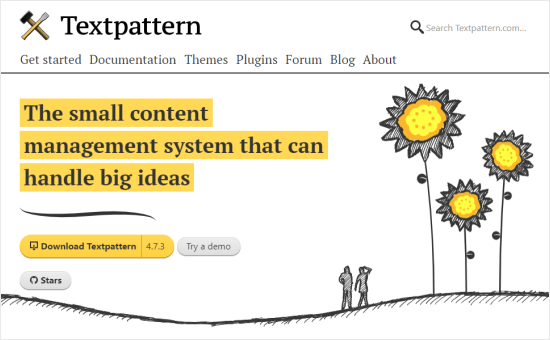
Textpattern is a simple, straightforward CMS platform that’s been available since 2003. It’s open source and has plenty of documentation to help you get started.
Pros
- There are lots of Textpattern modifications, plugins, and templates (designs) available completely for free.
- Textpattern has a flexible approach to how you structure your content. You can use “sections” and “categories” to organize it, and readers can subscribe to specific RSS feeds for different parts of your site.
Cons
- There’s no 1 click installation process for Textpattern with any of the major web hosts. It’s not too tricky to install, but you will have to be comfortable with creating a database on your web host and using FTP to upload the software.
- Textpattern isn’t particularly well known, and it’s much less popular than other CMS platforms like WordPress. You might find it hard to hire authors or developers who are familiar with it.
Pricing
Textpattern itself is completely free. You’ll need to have a domain name and web hosting account in order to use it to build a website.
11. Wix
Wix is a popular CMS platform, though it has some limitations. We often get readers asking how to switch from Wix to WordPress that’s because every smart business owner knows that WordPress is definitely better than Wix.
With that said, Wix is beginner-friendly and it might be worth considering. It offers a free plan, too.
Pros
- Wix’s drag and drop interface makes it really easy to create pages that look just how you want. You can select any part of your page and start editing it.
- There are lots of pre-made templates you can choose from in Wix. These are fully responsive, so they look great on mobiles and computers.
- You can add lots of apps to your site from the Wix App Market. These work like WordPress’s plugins to give your site new features.
Cons
- Once you’ve chosen a template on Wix, you can’t change to a different one. This could mean that you get stuck with a layout that’s not quite right for your site.
- You can’t run an eCommerce store on Wix unless you upgrade to a paid plan, and even then, you can only accept payments using PayPal or Authorize.net.
- Wix doesn’t allow you to easily download your data and export it. You can download your blog posts (though not your images) to move them, but if you have any pages on your site, you’ll need to copy and paste these manually. We have full instructions on how to move your Wix site to WordPress.
- If you’re using the free plan, you’ll have a Wix-branded domain name and ads on your site. The ads make money for Wix, not you.
Pricing
You can use Wix for free, if you’re happy with a Wix-branded domain name and ads running on your site. The paid plans offer more flexibility and start from $13 per month (paid upfront annually).
If you want to take online payments, you’ll need to pay $23/month or more (again, upfront annually).
12. Blogger
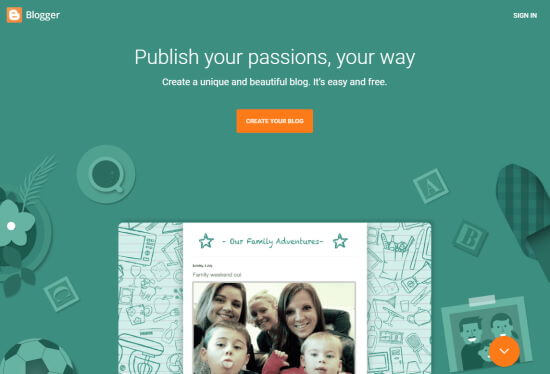
Blogger has been around since 1999. As you can tell from the name, it’s a CMS platform that’s specifically geared up for blogging. It’s a free service provided by Google.
Blogs on Blogger normally have blogspot in the domain, though it’s possible to use your own domain name instead.
We’ve got an article looking at WordPress vs Blogger and a guide on how to switch from Blogger to WordPress.
Pros
- Blogger is easy to get started with. You can set up a blog in minutes, and it’s well designed for writing and publishing posts.
- There are a number of gadgets that you can add to your blog for free so that you can include things like a contact form and even ads on your blog.
- Your blog is hosted by Google. You don’t need to install anything, update anything, or pay for hosting.
- Blogger offers a generous amount of space. There’s no limit on how many posts you can have per blog, and you can have up to 20 static pages. Your images are stored in Google Drive, so they’ll count towards your 15GB limit there.
Cons
- If you want to run a website that isn’t a blog, Blogger won’t be the best CMS platform for you. It doesn’t have any eCommerce features, for instance.
- While all the themes available are free, they’re pretty basic. You can modify them a bit, but you can’t create your own themes. If you want something more specialized, you’d need to hire a designer.
- While you can export your posts if you want to switch from Blogger to WordPress, you’ll need to copy your pages over manually.
Pricing
Blogger is completely free and you won’t be charged anything, unless you choose to buy a custom domain name.
If you do buy a domain name, it’s best to get it from a domain registrar, not from Blogger itself. That way, you can more easily move your site away from Blogger in the future.
13. Bitrix24
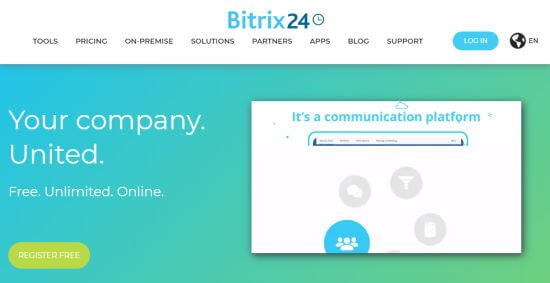
Bitrix24 is a business tool that offers a CMS platform alongside other features like the ability to manage your tasks, projects, communications, and customer relationships.
It’s free at the basic level (which offers up to 5GB of online storage and 12 user accounts) and offers an all-in-one solution for small businesses. If you want a CRM (Customer Relationship Management) tool, it could be a good choice.
Pros
- The basic level of Bitrix24 is free, meaning you can try it out without committing anything.
- There are a huge number of features included with Bitrix24, giving you everything you need to manage a small to medium-sized company.
- The website builder has a drag and drop interface that includes landing pages and even eCommerce stores.
- Your website hosting is free (if you’re on the free plan).
- Bitrix24 is really geared up for use as a CRM, so if you’ve already got a CRM you’re happy with or you don’t want that functionality, it’s a rather complicated way to get a CMS platform.
- As there are so many features, you may find the Bitrix24 interface confusing or tricky to navigate.
- TYPO3 can handle really large websites, including ones that have multiple websites in different languages. It’s a good option for large international companies.
- Because it’s open-source, TYPO3 can be extended however you want, if you’re willing to hire a developer to work for you.
- You can easily modify the access rights of different individuals and groups who work on your site.
- There are over 6,000 extensions and applications that you can add to your TYPO3 site to include new features.
- There aren’t all that many themes available, so you’ll likely have to hire someone to create one for you.
- You’ll need a pretty high degree of technical expertise to get TYPO3 up and running, and to maintain it.
- There’s a large PrestaShop community. This includes an official forum where tips and tutorials are shared, plus lots of other groups.
- You won’t have to pay extra as your shop grows (unless you need to upgrade your hosting plan).
- There are loads of PrestaShop modules, so you can add new features easily.
- It doesn’t cost much to get started with PrestaShop, especially if you’re on a cheap shared hosting plan.
- PrestaShop can have quite a steep learning curve to begin with.
- There are plenty of themes (designs) available from PrestaShop, but a lot of these aren’t very good. You may have to spend a long time looking through them to find something that’ll work for your online store.
Cons
Pricing
The Start+ plan costs $24/month, and the Professional plan costs $199/month, with a range of options in between. You get a discount if you pay for the year upfront.
You can also opt to purchase the software to use within your organization (instead of paying a monthly fee and using it online). This costs from $1,490.
14. TYPO3
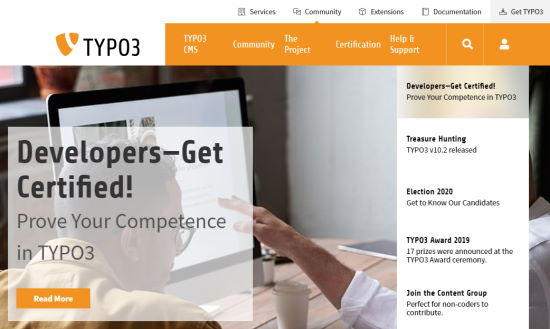
TYPO3 is a free, open source CMS platform that has been around even longer than Blogger. It was originally released in 1998. It’s an enterprise CMS, which means it’s useful for intranet sites (internal company sites) as well as websites.
There are a number of extensions available for TYPO3 that offer extra functionality, too.
Pros
Cons
15. PrestaShop
PrestaShop is an open source eCommerce CMS platform. You host it yourself, so you can install it on any web host that supports it. We recommend using SiteGround’s PrestaShop hosting.
Pros
Cons
Pricing
PrestaShop is free, though you’ll need to pay for your web hosting and a domain name. The modules and themes available through the PrestaShop Addons Marketplace could add up a lot, though. Most start from $59.99.
Which is the Best CMS Platform?
We believe that WordPress.org is the best CMS platform and website builder in the world. Over 35% of all websites on the internet is powered by WordPress, and there’s a good reason for that.
WordPress has everything you want in a perfect CMS platform. It’s easy to get started, and many WordPress web hosting companies offer a 1 click install process. You can extend the functionality in almost any way you can think of using plugins (which are like apps for WordPress).
On WordPress, you could run an eCommerce store, an online forum, a LMS (learning management system), a membership site, an auction site, a marketplace, and almost anything else you can think of.
There are no limits on what you can do with WordPress, and if you find that you need more space for your site as it grows, you can easily upgrade your hosting to managed WordPress hosting company.
To get started with WordPress, we recommend using either Bluehost or SiteGround for web hosting as they’re both officially recommended by WordPress.
Frequently Asked Questions About CMS (FAQs)
In case there’s still more you want to know about CMS platforms, we’ve put together this list of frequently asked questions.
Which CMS platform is best for eCommerce?
The best eCommerce CMS platform is WordPress with WooCommerce. While other eCommerce platforms are good too, we think WooCommerce is the best one out there for most online store owners.
You might want to take a look at our comparisons of Shopify vs WooCommerce and BigCommerce vs WooCommerce for an in-depth look at the pros and cons of those platforms.
Which CMS platform is best to build a small business website?
WordPress makes it super easy to build a small business website. It has a very wide range of themes (designs) to choose from and enables you to use all the tools you’ll need to grow your business.
Can I use a CMS platform without a domain name or hosting?
All websites need hosting. Sometimes this is provided by the company who has created the platform (like with Blogger) and sometimes it’s something you buy from an independent web host (like when using WordPress).
If you choose a free platform like Blogger or WordPress.com, you can use their free subdomain to start your blog, such as yourname.blogspot.com. This doesn’t look very professional, though, so you’ll almost certainly want to register a domain name at some point.
Do I need a CMS to start a blog?
Yes, a blogging platform is a type of CMS that allows you to easily publish content. There are lots of different blogging platforms available. Our article on best blogging platforms compares a number of both free and paid options.
We hope this article helped you learn more about the best CMS platforms. You may also want to take a look at our step by step guide to creating a WordPress website for help on getting started with WordPress.
If you liked this article, then please subscribe to our YouTube Channel for WordPress video tutorials. You can also find us on Twitter and Facebook.
The post 15 Best and Most Popular CMS Platforms in 2020 (Compared) appeared first on WPBeginner.
February 14, 2020 at 06:35PM