Wednesday, August 4, 2021

Semrush vs Ahrefs vs Moz – Which One is Better? (Pros and Cons)

Are you comparing Semrush vs Ahrefs vs Moz?

Semrush, Ahrefs, and Moz are the top three SEO tools on the market. They allow you to do keyword research, competition analysis, track SEO rankings, monitor backlinks, and more.

In this guide, we’ll compare the pros and cons of Semrush vs Ahrefs vs Moz to find out which one is better.

Comparing Semrush vs Ahrefs vs Moz

Why Use an SEO Tool for Your Online Business?

An SEO tool helps you improve your website’s performance on search engines. Choosing the right SEO tool helps you get more traffic from search engines and grow your business.

Following are just a few things that you can do with Semrush, Ahrefs, or Moz.

Track Your Search Engine Rankings

All three platforms allow you to easily track your search engine rankings. You can simply add your website URL to see how your site is doing in search. You can also manually track keywords and monitor your search rankings.

Optimize Your Content for Higher Rankings

All three SEO software tools help you optimize content for higher rankings. They include site and content audit tools that provide easily actionable tips to improve your SEO.

Track Competitors

You can also spy on your competitors just as easily as you would monitor your own website. You can see who is linking to your competitors, what keywords they are ranking for and then beat them on all those keywords.

Find Keyword Ideas

Struggling with keyword ideas to get more traffic? All top SEO software tools help you find keyword ideas with higher search volumes that you can easily rank for.

Track Backlinks

These SEO software help you track backlinks to any URL on your website or your domain name. You can see who links to your website and improve your link-building strategy with real insights.

These are just the top advantages of using an SEO software tool for your website.

Depending on which platform you choose you would also get many other features such as keyword ideas for paid advertising (PPC), Social Media analysis, local SEO, content marketing tools, keyword research, on-page SEO, and more.

That being said, now let’s take a look at each one of these top three SEO platforms and how they stack up in terms of features, ease of use, and pricing.

1. Semrush

Semrush website

Semrush is one of the best SEO tools on the market. It was founded in 2008 as a Firefox SEO extension called SEO Digger, which was later renamed SeoQuake, and then became Semrush.

Semrush offers an incredibly powerful all-in-one platform to manage your search and content marketing strategy under one roof.

Let’s take a look at some of the Semrush features.

Semrush Features:

  • Keyword research tool – Find keyword ideas and track your performance on any keywords.
  • Competition research – Spy on your competitors, see their organic and paid keywords, and top content. Not sure about who your competitors are? Simply enter your own domain name to find out your competitors.
  • Local SEO monitoring – Manage your listing, perform a site audit, track search position, and more.
  • Comprehensive advertising monitoring – PPC keyword tool, domain monitoring, advertising research tool, and more.
  • Social Media – Directly post ads to social media platforms, track social media postings, and research social media ads.
  • Content analysis tool – Check your content for SEO performance with practical tips to improve it.
  • Beautiful reports – You can generate and download beautiful reports for individual projects. You can also create custom reports for different domains, URLs, or Keywords.

When it comes to features, Semrush is the most comprehensive SEO software on the market.

Ease of Use:

Semrush offers a ton of data which could be overwhelming for a new user.

Luckily, it offers the most easy-to-use dashboard that just works. There is a search bar at the top where you can just add any domain, keyword, or URL to get started.
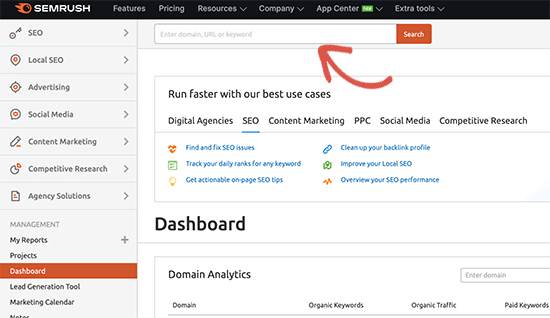
Semrush dashboard

On the left, you get all the tools in a neatly organized layout. Each section comes with its own dashboard that works similarly to the main search tool. For instance here is the content marketing dashboard.

Content marketing dashboard in Semrush

Semrush offers a robust help center with tons of how-to guides and tutorials to help you get started. They also a knowledge base and Semrush Academy where you get access to dozens of SEO courses.

Semrush support

Semrush Pricing: Starting from $99.5 / month

Our Rating: A+

Semrush offers the most comprehensive SEO software toolkit on the market. The data behind Semrush’s platform is massive which gives you access to incredible insights into search engine marketing.

Most importantly, we find Semrush to be the most beginner-friendly SEO tool. Once you enter a URL or keyword, it gives you all the information you need in an easy-to-understand format.

WPBeginner users can use our Semrush coupon to get a 30-day free trial.

2. Ahrefs

Ahrefs website

Ahrefs is another top SEO tool on the market with a comprehensive toolkit. Founded in 2010 as a site explorer tool, Ahrefs has grown into a full-fledged SEO platform for businesses, agencies, and SEO professionals.

It comes with all the features that you would get with any other SEO software in a simpler interface and tons of learning resources.

Ahrefs Features:

  • Site Audit – Ahrefs comes with a powerful site audit tool that you can use to optimize your website
  • Site Explorer – Spy on your competitors’ websites with Ahrefs site explorer tool. Unlock their top keywords and content and learn why they rank higher on those search terms.
  • Keyword Explorer – Find out keyword ideas for your domain name and track your search performance on different keywords.
  • Content Explorer – Find the most popular content for any keyword / topic. See exactly why they rank higher and replicate their strategy in your own content.
  • Clicks data – Ahrefs provides click data for keywords which helps you understand not just search volume but an estimated click rate too.
  • Keyword Tracker – Easily track SERPs for specific keywords. You can filter the tracking by geographic location, desktop and mobile.

Ahrefs provides all the tools you would want in your SEO toolkit. However, it lacks PPC advertising data for keyword research. It also lacks social media monitoring tools when compared with Semrush.

Ahrefs Ease of Use:

Ahrefs is very easy to use out of the box. They offer a simple dashboard with all the tools neatly tucked into different sections.
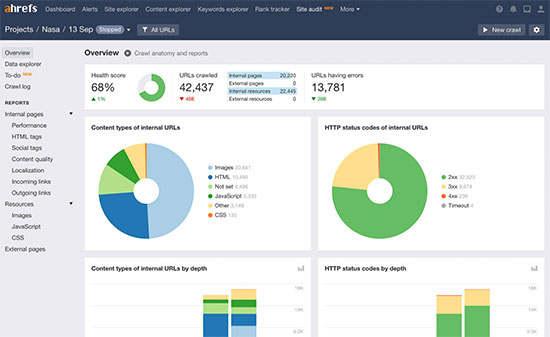
Ahrefs dashboard

Navigating around each tool is quite easy and you can find on-screen help as you explore different areas. They also have an instant help icon on each page so you can get to the support team much quicker.
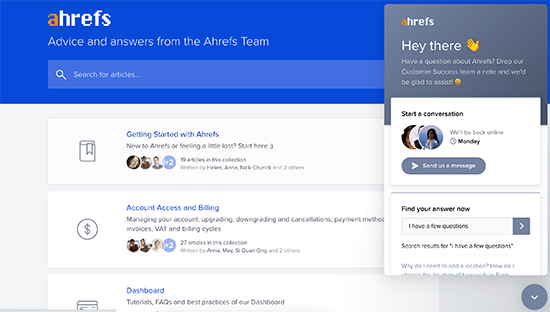
Ahrefs support

Ahrefs has an extensive library of articles, how-to guides, video tutorials and SEO resources. These come in handy if you are unfamiliar with a specific tool and want to learn how to make the most out of it.

Ahrefs Pricing: Starting from $99 per month.

Our Rating: A

Ahrefs offers a complete toolkit to manage SEO for your website and online business. It is easy to use and offers more proactive help across the platform than other tools. It does lack social media monitoring and PPC campaign features offered by Semrush, which may be a deal-breaker for some users who want to track those inside their SEO platform.

3. Moz

Moz website

Moz is another popular contender for the best SEO software toolkit on the market. Founded in 2004 as an online community called SEOmoz which later became a consultancy agency and then an SEO toolkit.

They offer a professional toolkit for small businesses, SEO professionals, and agencies.

Let’s take a look at some of the features of Moz and see how they stack up against the competition.

Moz Features:

  • Keyword research tool – Moz offers an easy-to-use keyword research tool. Simply enter a domain name to get the top-ranking keywords.
  • Site audit tool – Perform a complete site audit to see how your website is doing in search. The tool shows you errors, crawl issues, and makes actionable recommendations
  • On-page SEO – Get content optimization tips for keywords and URLs, find similar topics, and follow a step by step guide to improve existing content
  • Backlink research – Moz comes with a link tracker tool that allows you to monitor your website’s backlink.
  • Generate reports – You can download the automatic reports or create your own custom reports. Moz also provides templates to easy generate reports for domains, URLs, and keywords.

Moz offers all the basics that you will need to manage your website’s SEO. However, it lacks many features included in the other two platforms.

Ease of Use:

Moz offers a similar dashboard to the other two SEO tools mentioned above. Upon login, you get a quick overview of your projects with charts and a summary.
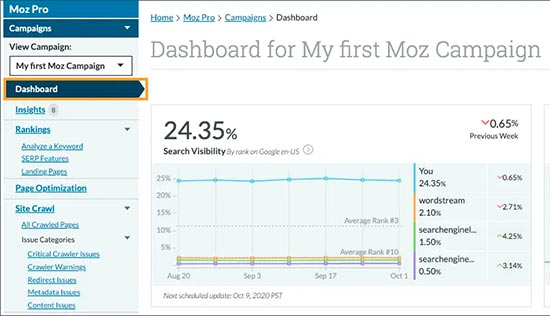
Moz dashboard

Different SEO tools are organized in a sidebar column. Each section comes with an easy interface that makes it easy to understand and follow along.
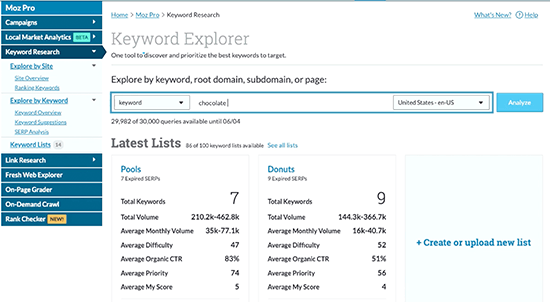
Moz keyword explorer

The platform also has an extensive help section with detailed how-to guides, tutorials, and articles.

Moz support

Pricing: Starting from $99 per month

Our Rating: B+

Moz offers a robust platform to manage your website SEO. However, it lacks many of the features available in the other contenders on the list. For instance, advertising tracking, social media monitoring, content optimization tool, and more.

Bonus Tool: All in One SEO
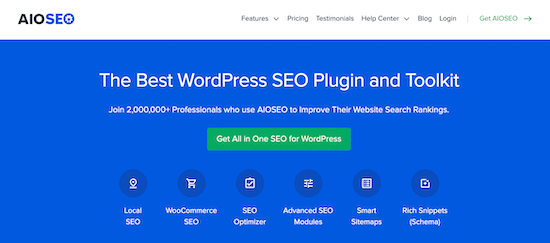
AIOSEO

All in One SEO for WordPress is the best WordPress SEO plugin on the market. It is the perfect companion for the top 3 SEO software mentioned above.

It helps you easily optimize your WordPress website for SEO. It is beginner-friendly and works out of the box for users who don’t have any technical SEO skills.

All in One SEO Features:

  • TruSEO On-Page Analysis – All in One SEO gives you an on-page SEO score as you create content on your website with easy tips to improve SEO before publishing it.
  • Rich Snippets – Comes with complete Schema markup support that allows your website to appear in rich results.
  • XML Sitemaps – Advanced XML sitemaps for your WordPress site that you can easily configure
  • Local SEO – Comes with Local SEO support to improve your site’s performance in local searches.
  • Ecommerce SEO – All in One SEO works out of the box for eCommerce websites.
  • SEO Audit – Perform a site-wide SEO audit with an actionable checklist

For more details, see our complete guide on how to setup All in One SEO for WordPress.

Ease of Use:

All in One SEO is incredibly easy to use. It comes with a setup wizard that walks you through the basic setup regardless of skill level and SEO expertise.
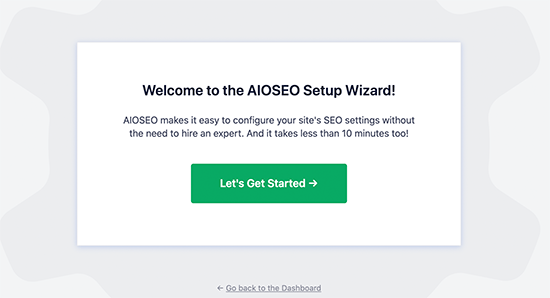
All in One SEO set up wizard

It integrates with your WordPress website. This allows you to make SEO an integral part of your routine and prepare your content for SEO as you work on your site.
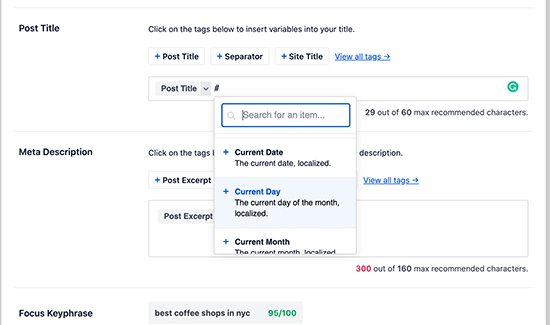
Title and Meta tag settings in AIOSEO

It gets out of your way and allows you to focus on creating content. At the same time, advanced users can configure settings and use a more hands-on approach to tweak SEO settings for different parts of their site.

Pricing: Starting $49.50 per year (free version available)

Our Rating: A+

We recommend using All in One SEO for WordPress on all websites. It helps you easily manage on-site SEO and works really well with any of the top 3 SEO software mentioned above.

Semrush vs Ahrefs vs Moz – Which One is Better?

We found Semrush to be the best SEO software tool on the market. It outperforms the competition in terms of features, ease of use, and value for money.

For site owners, we recommend using Semrush with All in One SEO. This gives you incredible tools to manage both on-site and off-site SEO.

Our second choice would be Ahrefs. While it is missing a few features offered by Semrush, it is still a great SEO toolkit.

We hope this article helped you compare the pros and cons of Semrush vs Ahrefs vs Moz. You may also want to check our complete WordPress SEO handbook or follow our guide on how to track conversions on your website.

If you liked this article, then please subscribe to our YouTube Channel for WordPress video tutorials. You can also find us on Twitter and Facebook.

The post Semrush vs Ahrefs vs Moz – Which One is Better? (Pros and Cons) appeared first on WPBeginner.


August 04, 2021 at 04:40PM

Tuesday, August 3, 2021

How to Add Simple and Elegant Footnotes in Your WordPress Blog Posts

Are you looking for an easy way to add footnotes to your articles?

Footnotes are additional pieces of information that you’ll see at the bottom of a page. It’s a common way to add citations, provide sources, and add clarity to your content.

In this article, we’ll show you how to add simple and elegant footnotes to your WordPress blog posts.

How to Add Footnotes in WordPress

Why Add Footnotes to Your Blog Posts?

Footnotes are a great way to provide references for your content at the bottom of an article. It helps build trust with your readers by showing them the source of your information.

You can also use footnotes to add comments, highlight important facts, and provide additional information on your content.

Footnotes can make your site look more professional and trustworthy. For instance, if you publish research papers or covers historical events, then your readers may be looking for footnotes with citations.

That being said, let’s look at how you can add footnotes to your WordPress website.

Add Footnotes in WordPress Using a Plugin

The easiest way to add footnotes to your content is by using a WordPress plugin. A plugin provides more flexibility and control over the styling of your footnotes, and you won’t have to edit code.

For this tutorial, we’ll be using the footnotes plugin for WordPress. While there are many other options, footnotes is easy to use, offers multiple options for customization, and is totally free.

First, you’ll need to install and activate the footnotes plugin for WordPress. For more details, you can refer to our guide on how to install a WordPress plugin.

Once the plugin is active, you can navigate to Settings » footnotes from your WordPress admin panel. You will now see different options to customize your footnotes.

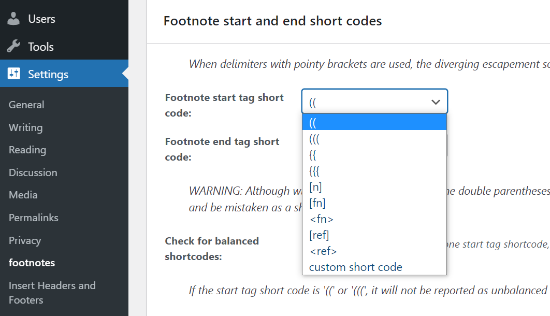
For instance, you can select the start and end shortcodes for your footnotes from the dropdown menu. Using these shortcodes, you’ll be able to add footnotes to your content.

Select start and end shortcodes

As long as you know what shortcode to use to add a footnote to your content, you can start using the plugin to add footnotes in your WordPress posts and pages. The rest of the settings are completely optional.

To add a footnote, go ahead and create a new post or edit an existing article. When you’re in the WordPress editor, simply add the shortcode you selected for the footnotes.

For example, if you choose double parenthesis as your shortcode, then insert it in the content where you want to add the footnote. Then you can enter the URL of your source, or whatever else you’d like to include in the footnote.

It would look something like this:

Add footnote shortcode in your content

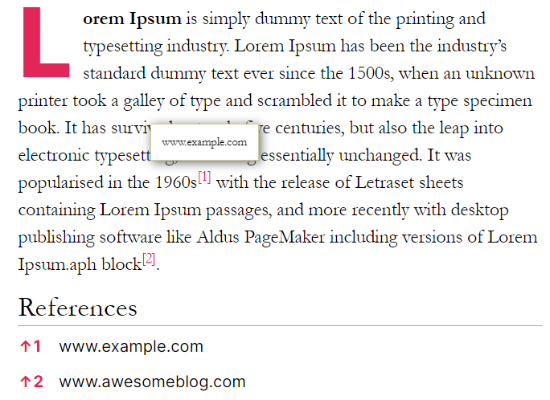
After that, you can preview your post to test if the footnote links are working properly. When you’re satisfied with the settings, go ahead and publish your WordPress blog post to see the footnotes in action.

Footnote example

Now, if you want to customize your footnotes and change their appearance, then the footnotes plugin offers multiple options.

You can start by going to the Settings » footnotes and click on the ‘General settings’ tab.

You’ll see settings for choosing a numbering style. The plugin lets you choose from plain numbers, Roman numerals, lower and upper case letters, and more.

Choose a Numbering Style

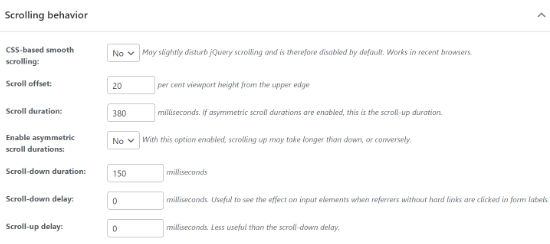
After that, you can configure the scrolling behavior of the footnotes in the content. There are options to set up scroll duration and add a delay when a visitor clicks on a footnote.

Configure the scrolling behavior

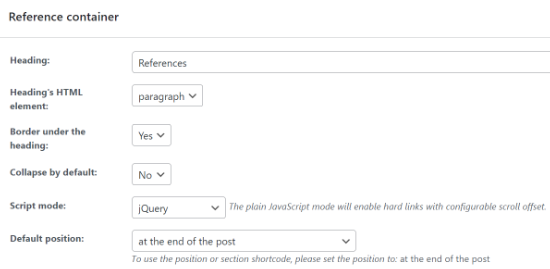
The plugin will use ‘References’ as the default heading for your links in the footnote, but you can change the heading text and how it displays in the ‘References container’ section.

Reference Container settings

The plugin offers more settings, such as showing footnotes in excerpts, configuring the URL fragment ID settings, and enabling AMP compatibility mode. When you’re done with the changes, click the ‘Save Changes’ button.

Next, you can head over to the ‘Referrers and tooltips’ tab. Here you’ll see settings to change the backlink symbol that will appear in the footnote links.

You can select from different symbols offered by the plugin or add your own. Along with that, there are options to change the referrer settings and choose whether you want footnote numbers to appear in brackets.

Change Referrer and Tooltips settings

Besides that, the plugin offers settings to enable tooltips, which is a text box that shows the link of your source when a user hovers over a footnote number. You can change the tooltip position, dimensions, timing, text, and use other options for customization.

In the the ‘Scope and priority’ tab, you can set the priority level which determines whether footnotes will run before other plugins.

In addition, you can add Custom CSS by going to the ‘Custom CSS’ tab. Don’t forget to click the ‘Save Changes’ button when you’re done making changes.

Manually Add Footnotes in WordPress using HTML

Aside from using a plugin, you can also add footnotes using HTML in your WordPress blog posts.

This method is more time-consuming, and your footnotes won’t work if you make any mistakes when entering the HTML code. For beginners and anyone who has never edited HTML before, we recommend that you use a plugin to add footnotes.

That said, HTML is a good option if you only need to add footnotes to a single post or page.

To start, you’ll first need to edit or add a new page or post. Next, head over to the content where you’d like to add the footnote.

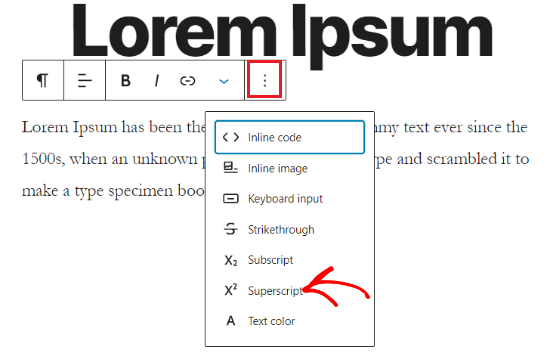
In your WordPress block editor, you can add superscripts by clicking the three-dots menu in the paragraph block and then selecting the ‘Superscript’ option.

Add Superscripts in WordPress block editor

Next, you’ll need to click the three-dots menu again and select the ‘Edit as HTML’ option. For more details, you can check out our guide on how to edit HTML in WordPress.

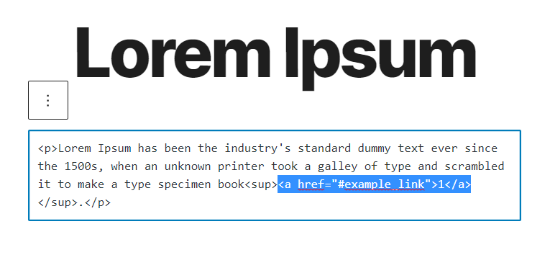
Once that’s done, go ahead and enter the following HTML code to your superscript number:

<a href="#example_link">your superscript</a>

It should look something like this:

Enter HTML code in WordPress editor

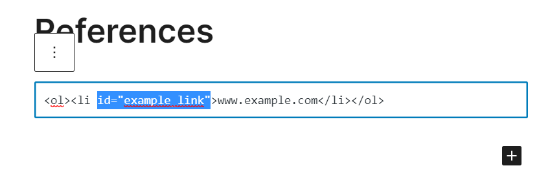
After that, you’ll need to add the following HTML code to your reference or citation link at the bottom of the post. This way, when a user clicks on the footnote number, they’re taken to the respective URL.

id="example_link"

Here’s what it would look like in the WordPress editor:

Enter HTML ID code to footnote link

Now go ahead and preview your blog post to check if the footnotes are working correctly. After that, you can publish your blog post and see the footnotes in action.

Footnote preview using HTML

We hope this article helped you learn how to add simple and elegant footnotes in your WordPress blog posts. You may also want to take a look at our guide on how to choose the best blogging platform, or see our expert comparison of the best free website hosting.

If you liked this article, then please subscribe to our YouTube Channel for WordPress video tutorials. You can also find us on Twitter and Facebook.

The post How to Add Simple and Elegant Footnotes in Your WordPress Blog Posts appeared first on WPBeginner.


August 03, 2021 at 04:00PM

Monday, August 2, 2021

How to Update Your PHP Version in WordPress (the RIGHT Way)

Do you want to update the PHP version of your WordPress site?

Using the latest PHP version for your WordPress website improves performance and website speed. However, sometimes your web hosting company may be using an older version of PHP.

In this article, we’ll show you how to easily update the PHP version of your WordPress website.

Updating the PHP version for your WordPress website

Why Update the PHP Version of Your WordPress Site

WordPress is developed using an open-source programming language called PHP. At the time of writing this article, WordPress requires at least PHP version 7.4 or greater. The current stable version available for PHP is 8.0.8.

Most WordPress hosting companies use PHP versions 7.4 or higher to meet the minimum WordPress requirements.

Each PHP version improves performance by more efficiently running processes and reducing memory usage. This impacts your WordPress site speed by making it faster and reducing the load on your server.

Normally, WordPress hosts automatically update PHP version in the background. These updates have no effect on most websites, and you may not notice any change at all.

Occasionally, a plugin on your WordPress website may misbehave due to incompatibility with a newer PHP version. In that case, some website owners may want to switch back to the older PHP version until a plugin update fixes that issue.

How to Check the PHP Version in WordPress?

WordPress makes it super easy to check the PHP version used by your hosting provider.

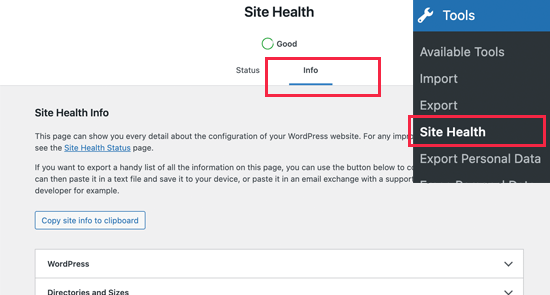
Simply login to the admin area of your WordPress website and go to the Tools » Site Health page and switch to the ‘Info’ tab.

Info section under WordPress Site Health tool

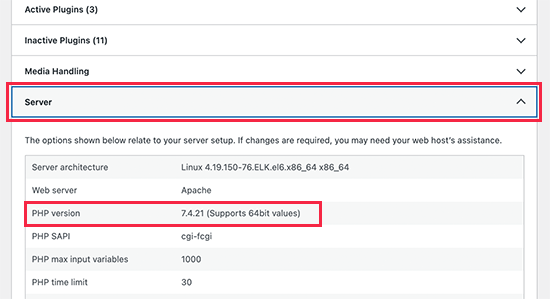
Next, you need to scroll down a little and click to expand the ‘Server’ tab. This section shows server information including the PHP version used by your server.

PHP version displayed in Site Health tool

As you can see, in the screenshot above our demo website is using PHP version 7.4.21.

Updating the PHP Version on Your WordPress Site

All top WordPress hosting companies allow you to easily change the PHP version used by your website. We’ll show you a few examples from top hosting providers.

Changing PHP Version in Bluehost

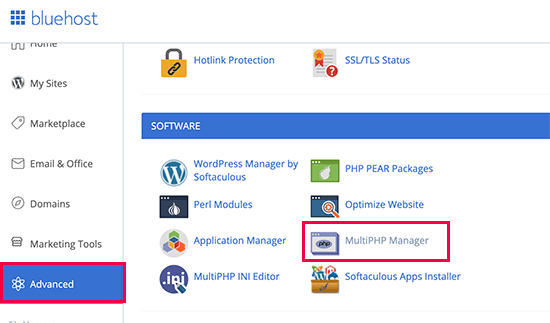
First, you need to login to your Bluehost hosting account dashboard and click on the Advanced tab in the left column.

PHP manager Bluehost

This will bring you to the advanced tools page to manage your hosting account. From here you need to click on the MultiPHP Manager icon.

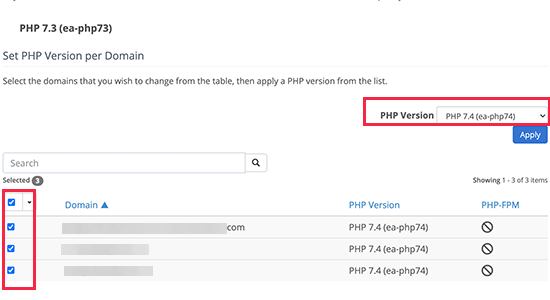
On the next page, you need to select your website and then select the PHP version that you want to use.

Changing PHP version in Bluehost

Click on the Apply button to save your changes.

Bluehost will now start using the PHP version you selected for your website.

Changing PHP Version in SiteGround

If you are using SiteGround hosting, then here is how you would update the PHP verison of your WordPress website.

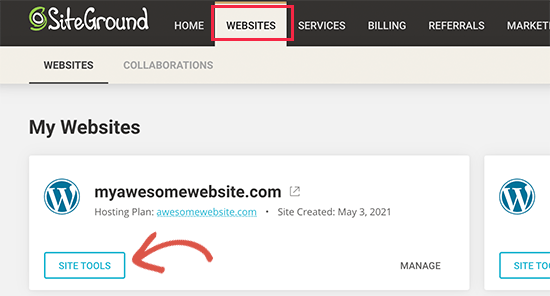
First you need to login to your SiteGround account dashboard. After that, you need to switch to the ‘Websites’ page and then click on the Site Tools button next to your website.

Site Tools section on SiteGround

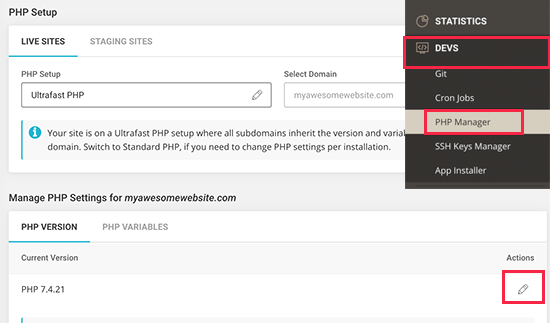
Next, you need to go to DEVS » PHP Manager from the left column. From here you can choose to use SiteGround’s Ultrafast PHP or Standard PHP. You can also change the PHP version number by clicking on the Edit icon.

PHP Manager in SiteGround

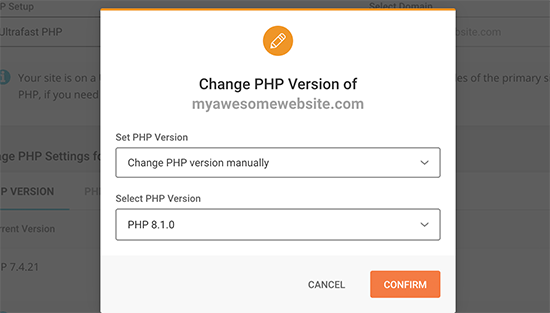
This will bring up a popup where you first need to select ‘Change PHP version manually’ under the ‘Set PHP Version’ option.

Changing PHP version in SiteGround

After that, you would be able to select your PHP version from a drop down menu. Don’t forget to click on the Confirm button to apply your changes.

Changing PHP Version in HostGator

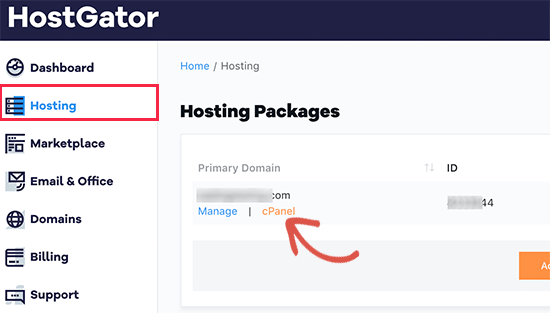
First you need to login to your HostGator hosting account dashboard and then click on the Hosting section. From here you need to click on the cPanel link under your hosting account.

Launch HostGator cPanel dashboard

This will launch cPanel dashboard where you can manage advanced settings for your hosting account. You need to scroll down to the Software section and click on the MultiPHP Manager icon.

Launching MultiPHP manager in HostGator

Next, you need to select your domain name and then choose the PHP version. Don’t forget to click on the Apply button to save your settings.

Changing PHP Version in WP Engine

WP Engine is a managed WordPress hosting company which means they automatically upgrade the PHP version for you. However, you can also manually upgrade and downgrade the PHP version for your websites.

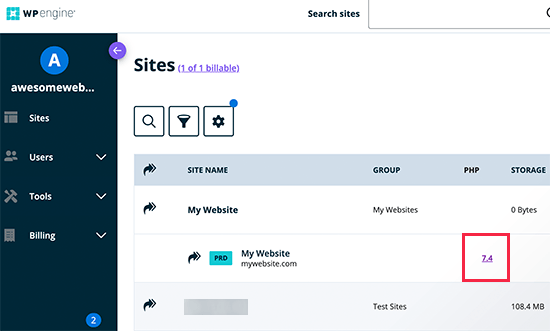
Simply login to your WP Engine dashboard and click on the PHP version next to your website.

Changing PHP version in WP Engine

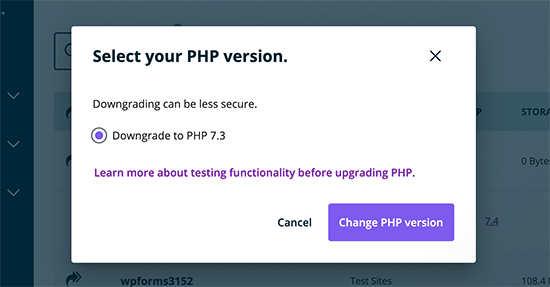
This will bring up a popup where you can choose to downgrade or upgrade the PHP version for your WordPress website.

Upgrade or downgrade PHP version in WP Engine

Don’t forget to click on the ‘Change PHP Version’ button to save your changes.

Changing PHP Version in Other WordPress Hosting Environments

Most WordPress hosting companies use similar hosting dashboards with some customizations. Usually, you will find the MultiPHP Manager icon in the cPanel dashboard.

If you cannot find it, then you can contact your WordPress hosting provider and ask them to change the PHP version of your website.

Things to Do After Updating PHP Version of Your Website

After updating the PHP version for your WordPress website, you may want to make sure that everything is working as expected.

We recommend visiting your website to see if there are any immediately noticeable issues.

After that, you can login to the WordPress area of your website. Make sure your website is using the latest version of WordPress and all your plugins and WordPress theme are updated. See our beginner’s guide on how to safely update WordPress.

Lastly, it is always recommended to make a complete backup of your WordPress website.

What to Do if a PHP Update Breaks Your WordPress Site?

There are very little chances of a PHP update breaking your WordPress site. However, with the abundance of free and paid plugins, there is a chance that a single line of poor code can result into an error.

The first thing you need to do is make sure that it is not a plugin or theme causing this error. To do that deactivate all your WordPress plugins and switch to a default WordPress theme.

If this does not solve your issue, then contact your web host’s support team. There is a good chance that the issue you are facing will already be in their notice, and they will be able to assist you.

If your web host is unable to help you out, then you can downgrade your PHP version using the methods described above.

We hope this article helped you learn how to update the PHP version of your WordPress site. You may also want to see our guide on how to create an email newsletter, or our comparison of the best live chat software for your website.

If you liked this article, then please subscribe to our YouTube Channel for WordPress video tutorials. You can also find us on Twitter and Facebook.

The post How to Update Your PHP Version in WordPress (the RIGHT Way) appeared first on WPBeginner.


August 02, 2021 at 03:30PM